<?xml version="1.0" encoding="utf-8"?><feed xmlns="http://www.w3.org/2005/Atom" xml:lang="en"><generator uri="https://jekyllrb.com/" version="4.4.1">Jekyll</generator><link href="https://demarty.ch/feed.xml" rel="self" type="application/atom+xml" /><link href="https://demarty.ch/" rel="alternate" type="text/html" hreflang="en" /><updated>2026-11-01T22:33:04+01:00</updated><id>https://demarty.ch/feed.xml</id><title type="html">Gilles Demarty</title><subtitle>Coach, mentor and UX strategist in Lausanne, Switzerland</subtitle><author><name>Gilles Demarty</name></author><entry xml:lang="en"><title type="html">5 definitions of user experience design</title><link href="https://demarty.ch/blog/definitions-dun-ux-designer/" rel="alternate" type="text/html" title="5 definitions of user experience design" /><published>2014-11-06T09:16:01+01:00</published><updated>2014-11-06T09:16:01+01:00</updated><id>https://demarty.ch/blog/ux-design-definitions</id><content type="html" xml:base="https://demarty.ch/blog/definitions-dun-ux-designer/"><![CDATA[<p>Following my <a href="/blog/je-ne-suis-pas-un-ergonome/">previous article</a>, it now seems important to define what UX Design (User eXperience Design) is and, by extension, what a UX designer is.</p>

<p>In his article on design education (<a href="http://www.jstor.org/discover/10.2307/1511466?uid=3738016&amp;uid=2&amp;uid=4&amp;sid=21102511263241">Moholy-Nagy’s Design Pedagogy in Chicago (1937-46)</a>), Alain Findeli sets the tone:</p>

<blockquote>
  <p>“Anybody who has been confronted with design education would readily admit that proposing a satisfactory definition of Design is a rather risky, if not impossible, enterprise. Its definition indeed depends on whether design is considered to be an idea, a knowledge, a project, a process, a product or even a Way-of-being.”</p>
</blockquote>

<p>So I’m clearly setting out on a risky journey into defining user experience design. Still, I think it’s a necessary step to define my own practice and explain it to people outside the industry.</p>

<p>It’s reductive to describe UX Design as “ergonomics” or “graphic design”, just as it’s reductive to describe it as web design or app design.</p>

<p>Given the size of the task, rather than offering one unifying definition, I’ll describe UX design from five different angles.</p>

<p>Here is where my thinking stands.</p>

<h2 id="definition-1-ux-design-as-the-design-of-the-user-experience">Definition 1: UX Design as the <em>design</em> of the <em>user experience</em></h2>

<p>The most immediate definition, the closest to the very essence of UX Design, is that UX Design is the design of the user experience, just as product design is the design of a “product”. UX Design is then a design discipline, and the user experience is the material the designer works with.</p>

<p>So let’s define the user experience: <a href="/blog/je-ne-suis-pas-un-ergonome/">as Marc Hassenzahl explains</a>, it comes from a recent shift in society: from consuming products to consuming experiences.</p>

<p>This shift towards an experience society has also been anticipated and recognised by fields other than design, such as business and marketing.</p>

<p>Jared Spool, for his part, <a href="https://vimeo.com/20881152">described it as the gap between several activities</a> (or tasks) lived between a customer and a service. He takes the example of the “experience” at Disneyland Paris, where the different rides dissolve into the overall “Disney” experience.</p>

<h2 id="definition-2-ux-design-as-a-problem-solving-tool-mostly-digital">Definition 2: UX Design as a problem-solving tool (mostly digital)</h2>

<p>By definition, design is a creative method for solving problems in two key moments: reframing and repositioning the problem, and exploring the solution space to bring out a “good” solution.</p>

<p>Of course, designers aren’t the only ones whose job is solving problems. To be honest, every service and scientific profession solves problems. What makes designers unique is the nature of the problems they solve: problems solved by design are, in essence, non-deterministic (see the definition of <a href="http://en.wikipedia.org/wiki/Wicked_problem">wicked problems</a>).</p>

<blockquote>
  <p>Wicked problems are a class of social system problems which are ill-formulated, where the information is confusing, where there are many clients and decision makers with conflicting values, and where the ramifications in the whole system are thoroughly confusing.</p>
</blockquote>

<p>The design process guarantees a better result than having no design process (but not the best possible result). That said, the designer’s solution won’t meet every stated constraint, but it will define the essence of what gets made. The designer works towards that by exploring the problem space and then the solution space, iteratively and (often) visually: building sketches and prototypes as concrete outputs, and knowing the limits and possibilities of the material used (in our case, the experience).</p>

<h3 id="its-the-non-determinism-of-the-process-that-worries-clients">It’s the non-determinism of the process that worries clients</h3>

<p>A short aside here. In my previous assignment, I worked in an environment where design was fundamentally misunderstood (see the previous article). When I introduced myself as a UX designer, I was confused with ergonomists or graphic designers, whose goals were just as unknown but whose results were more visible. Either way, the value I added wasn’t really seen, because people assumed that:</p>

<ul>
  <li>I would propose a solution that couldn’t be built,</li>
  <li>I would spend more time finding a solution they’d have had anyway without me.</li>
</ul>

<p>At the heart of these concerns is a fear of the unknown, a place where we designers are naturally at home, and which is our strength.</p>

<h2 id="definition-3-ux-design-as-a-multidisciplinary-profession">Definition 3: UX Design as a multidisciplinary profession</h2>

<p>Surprisingly, an activity as fuzzy as UX Design breaks down <a href="http://www.alphabux.net/2012/10/clarifying-the-disciplines-of-ux-or-dtdt-part-1/">into many skills or disciplines</a>, all more or less well defined:</p>

<ul>
  <li>Interaction design,</li>
  <li>Information architecture,</li>
  <li>Visual design or graphic design.</li>
</ul>

<p>Many other fields are also present, either at the core of the UX designer’s practice or as inspiration:</p>

<ul>
  <li>Cognitive ergonomics</li>
  <li>Human sciences</li>
  <li>Project management</li>
  <li>Front-end development</li>
  <li>Architecture</li>
  <li>Product design</li>
  <li>Service design</li>
  <li>And many more!</li>
</ul>

<p>These professions, without being an integral part of the design process, are all disciplines the UX designer must know, if not master.</p>

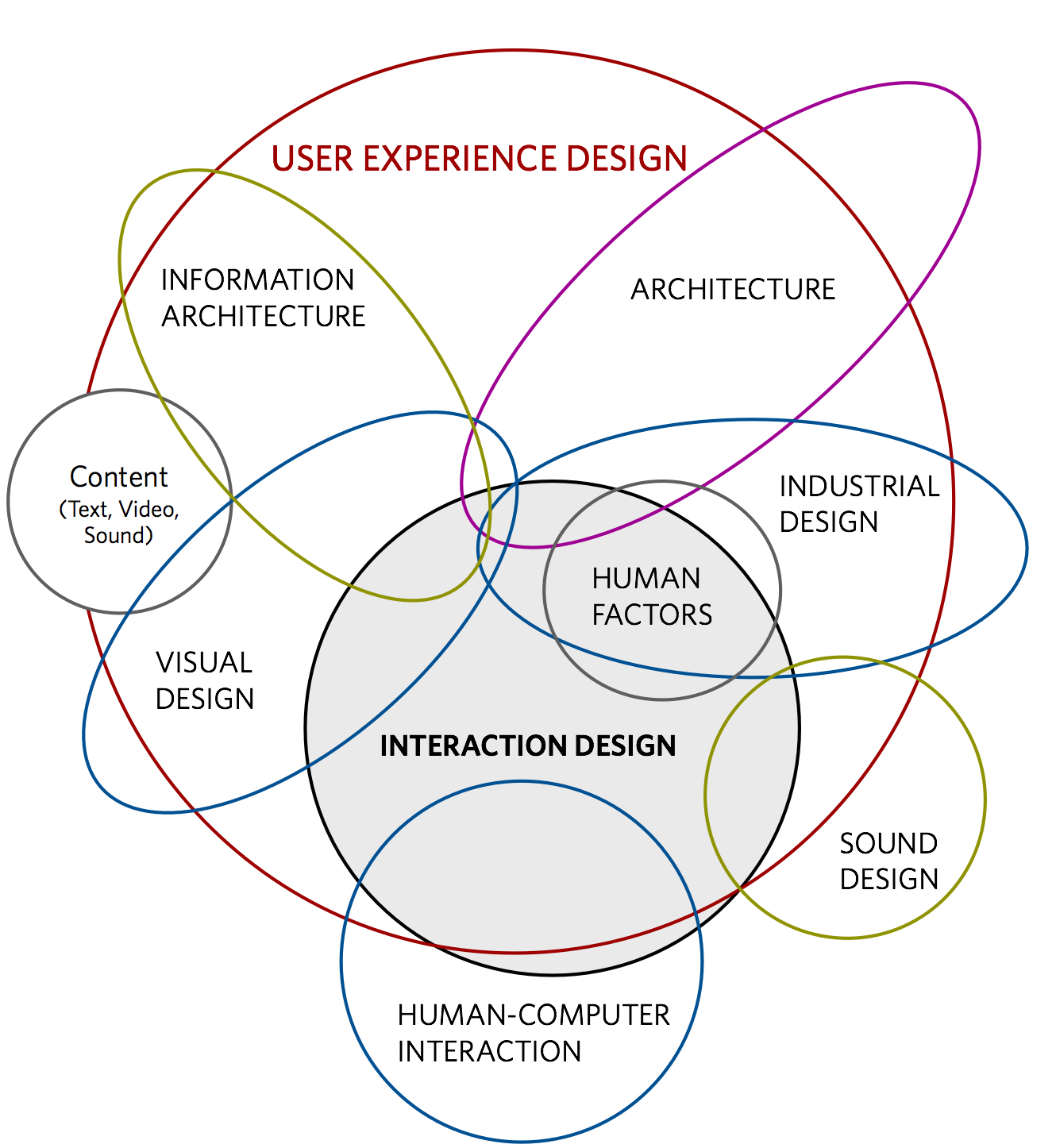
<p><img src="/assets/dan-saffer-s-disciplines-of-ux.jpg" alt="The disciplines of user experience by Dan Saffer" />
<a href="http://www.kickerstudio.com/2008/12/the-disciplines-of-user-experience/">The disciplines of user experience</a> by Dan Saffer</p>

<h3 id="the-ux-designer-has-a-t-shaped-profile">The UX designer has a T-shaped profile</h3>

<p>A UX designer is expected to have a T-shaped practice:</p>

<ul>
  <li>Broad, more or less applied knowledge across many fields, from ergonomics to front-end development, including psychology, typography, print design, interface design, and so on.</li>
  <li>But above all, one key skill in their practice that makes them unique.</li>
</ul>

<h3 id="facilitator-and-conversation-starter">Facilitator and conversation starter</h3>

<p>One strength of a UX designer is the ability to talk with everyone in the room, to translate and facilitate between trades. That’s also why they need to understand all these disciplines.</p>

<h2 id="definition-4-ux-design-as-a-company-philosophy-and-culture">Definition 4: UX Design as a company philosophy and culture</h2>

<p>Once design is established in a company, the company is radically transformed at its foundations. Signs that a company has made its “experience” shift:</p>

<ul>
  <li>The walls between departments come down,</li>
  <li>All departments are involved in designing the overall customer experience (CX),</li>
  <li>A real company-wide culture, disruptive and creative, that accepts failure, is present.</li>
</ul>

<p>Once the benefits of UX Design are understood, adoption can be quick.</p>

<h2 id="definition-5-ux-design-as-an-agent-of-change">Definition 5: UX Design as an agent of change</h2>

<p>Of course, not every company or organisation has reached full UX Design maturity.
For companies drawn to the design approach, the UX designer then acts as a catalyst, setting off a chain reaction wherever they go and raising the company’s overall maturity.</p>

<p>That’s what I consider user experience design to be, and what I believe I do day to day in my UX design practice.</p>]]></content><author><name>Gilles Demarty</name></author><category term="definitions" /><category term="ux design" /><category term="experience" /><summary type="html"><![CDATA[Following my previous article, it now seems important to define what UX Design (User eXperience Design) is and, by extension, what a UX designer is.]]></summary><media:thumbnail xmlns:media="http://search.yahoo.com/mrss/" url="https://demarty.ch/assets/portrait.jpg" /><media:content medium="image" url="https://demarty.ch/assets/portrait.jpg" xmlns:media="http://search.yahoo.com/mrss/" /></entry><entry xml:lang="en"><title type="html">User testing: the miracle recipe to convince anyone</title><link href="https://demarty.ch/blog/comment-convaincre-tests-utilisateurs/" rel="alternate" type="text/html" title="User testing: the miracle recipe to convince anyone" /><published>2014-10-24T10:16:01+02:00</published><updated>2014-10-24T10:16:01+02:00</updated><id>https://demarty.ch/blog/how-to-convince-user-testing</id><content type="html" xml:base="https://demarty.ch/blog/comment-convaincre-tests-utilisateurs/"><![CDATA[<blockquote>
  <p>25.10.2014: updated to include the questions from the comments</p>
</blockquote>

<p>Every month, someone tells me: “I’d like to run a user test, but I can’t!”</p>

<p>Recently, two things convinced me to write this article for you:</p>

<ul>
  <li>A friend asked me for help convincing a particularly reluctant client to run usability tests.</li>
  <li>Jérémie sent me this article: <a href="http://blog.oboxthemes.com/you-are-not-a-user-experience-designer/">You are not a designer (… if you don’t do usability tests)</a>.</li>
</ul>

<p>So here is my approach for convincing anyone of the importance of usability testing.</p>

<p>It comes in three steps:</p>

<ul>
  <li>How I run a test</li>
  <li>What the client gets out of it</li>
  <li>And I answer all the questions that follow.</li>
</ul>

<p>Nothing complicated. Let’s go.</p>

<h2 id="what-is-a-user-test">What is a user test?</h2>

<p><strong>I always start by explaining what a user test is, and how it differs from an acceptance test, a unit test or a focus group.</strong></p>

<p>A user test is quite simple:</p>

<ul>
  <li>Take 5 potential users of the platform, service, software or app you’re building.</li>
  <li>Have them use the application (or the mockups/prototypes that show it).</li>
  <li>Ask them to carry out real tasks.</li>
  <li>And (just) watch how they use it, and learn from their mistakes.</li>
</ul>

<p>Usability testing isn’t asking someone whether they like the product, but whether they can use it.</p>

<p><em>I often add that if you think you already know the answer to that question, I don’t think you know what you’re talking about.</em></p>

<h2 id="whats-in-it-for-the-client">What’s in it for the client</h2>

<p><strong>Then I explain what user testing brings to the person I’m trying to convince.</strong> I try to make clear what <em>I</em> will get out of the tests, and what the benefit is <strong>for the client</strong>.</p>

<ul>
  <li>The test shows whether what we’ve designed so far makes sense. We validate all the assumptions made during design. We find out what works and what doesn’t.</li>
  <li>We get a view of users’ mental model (how they talk, how they picture the things we put in front of them), which helps design the next features better.</li>
  <li>We reduce as much as possible the risk that the product we ship doesn’t fit!</li>
  <li>If the test goes well, we can show with numbers that the product is usable by its target audience and that it’s “good”. That should reassure the whole hierarchy before launch!</li>
</ul>

<h2 id="yes-but">Yes, but…</h2>

<p><strong>At this point, the person I’m talking to always comes up with one or more discouraging arguments. Here are the ones I hear most often, and the answer I find most fitting.</strong></p>

<h3 id="the-application-isnt-finished-its-only-a-prototype--mockups">The application isn’t finished… it’s only a prototype / mockups</h3>

<ul>
  <li>It will show where to put the effort next.</li>
  <li>It lets us test before we build.</li>
  <li>We’re grown-up enough to tell what comes from the mockup and what comes from the concept.</li>
</ul>

<h3 id="we-already-know-what-users-want">We already know what users want</h3>

<ul>
  <li>We’re not trying to find out what people want, but whether they can use what we offer them.</li>
  <li>Even if we were, asking them is rarely the right option (use the Henry Ford or Steve Jobs arguments).</li>
</ul>

<h3 id="users-havent-been-trained--its-a-specialist-product">Users haven’t been trained – it’s a specialist product</h3>

<ul>
  <li>Absolutely. That said, we can tell whether a problem comes from not knowing the product or from usability issues.</li>
  <li>And seeing what they try first gives us an idea of how they think.</li>
</ul>

<h3 id="we-want-to-test-with-more-users-5-isnt-enough">We want to test with more users, 5 isn’t enough</h3>

<p>Studies show that testing with 5 users reveals about 80% of an interface’s problems. It will take us a day, and we’ll have plenty to chew on.</p>

<h3 id="yes-but-we-dont-have-enough-time">Yes, but we don’t have enough time</h3>

<p>Come on, a test takes four days at most. Plenty of time. And if you take part in the tests with me, we can get it down to two.</p>

<h3 id="and-well-never-have-the-budget-to-act-on-the-feedback">And we’ll never have the budget to act on the feedback</h3>

<p>That’s tricky. The big question is: do you want an application full of features nobody wants or can use, or a product people understand and can use?</p>

<h3 id="but-everyone-is-different">But everyone is different</h3>

<ul>
  <li>Yes and no. Even if everyone has a different education and culture, everyone has fingers of a certain size, and roughly the same memory.</li>
  <li>For business applications, people often share a vocabulary and a way of thinking. Designing for what they have in common is the whole challenge.</li>
</ul>

<h3 id="but-youre-the-expert-you-should-know-what-will-be-usable">But you’re the expert, you should know what will be usable</h3>

<ul>
  <li>My whole design is built on assumptions: who the users are, what they do, what they know. Like any assumption, they need validating at some point. Do you want to validate them BEFORE the product goes on sale, or after? I’d say the sooner the better.</li>
  <li>You do test a product before release to make sure there are no bugs, don’t you? Well, user tests check there’s no gap between the proposed design and what users expect.</li>
</ul>

<h3 id="youve-already-done-an-expert-review-isnt-that-enough">You’ve already done an expert review, isn’t that enough?</h3>

<ul>
  <li>They’re complementary methods (obviously). Nothing replaces contact with real people. Once the software is in a user’s hands, you’ll see things no review could reveal.</li>
  <li>On the technical side: there are code reviews and unit tests to validate code. But they never replace functional tests and demos. Usability tests are the same.</li>
</ul>

<h2 id="what-next">What next?</h2>

<p>There you go, you now have my secret weapon. It may not convince everyone, but never mind. You have to start somewhere.</p>

<p>And if they’re convinced and you now have to take the plunge, take an hour to read Steve Krug’s famous <a href="https://sensible.com/rocket-surgery-made-easy/">Rocket Surgery Made Easy</a>. This great book gives you a ready-to-use method to run your first tests.</p>

<p>What about you: have you tried another approach to convince people? Have you heard other “Yes, but…”?</p>

<hr />
<p><em>Many thanks to my two reviewers, Guillaume Berry and Thomas di Luccio</em></p>]]></content><author><name>Gilles Demarty</name></author><category term="method" /><category term="usability" /><category term="user testing" /><category term="convincing" /><summary type="html"><![CDATA[25.10.2014: updated to include the questions from the comments]]></summary><media:thumbnail xmlns:media="http://search.yahoo.com/mrss/" url="https://demarty.ch/assets/portrait.jpg" /><media:content medium="image" url="https://demarty.ch/assets/portrait.jpg" xmlns:media="http://search.yahoo.com/mrss/" /></entry><entry xml:lang="en"><title type="html">Interaction13 Redux</title><link href="https://demarty.ch/blog/interaction13-redux/" rel="alternate" type="text/html" title="Interaction13 Redux" /><published>2013-04-19T10:16:01+02:00</published><updated>2013-04-19T10:16:01+02:00</updated><id>https://demarty.ch/blog/interaction13-redux-en</id><content type="html" xml:base="https://demarty.ch/blog/interaction13-redux/"><![CDATA[<h2 id="interaction-13">Interaction 13</h2>

<p>In February 2013, I went to Toronto for the <a href="http://interaction13.ixda.org">Interaction 13</a> conference.
<strong>Interaction</strong> is the conference of the Interaction Design Association (IxDA), an association I’m an active member of.</p>

<p>The conference runs over five days and is a chance for the UX design world to get together over a beer and intense discussions.</p>

<h2 id="the-redux">The redux</h2>

<p>Once back, I put together a summary of the conference’s main themes. Here is the result:</p>

<script async="" class="speakerdeck-embed" data-id="d47504f08aa70130968022000a1c84b1" data-ratio="1.33333333333333" src="//speakerdeck.com/assets/embed.js"></script>

<h2 id="interaction-14">Interaction 14</h2>

<p><a href="http://interaction14.ixda.org">Interaction 14</a> will take place in Amsterdam from 5 to 8 February 2014. I hope to see you all there!</p>]]></content><author><name>Gilles Demarty</name></author><category term="redux" /><category term="interaction" /><category term="ixda" /><category term="Interaction Design Association" /><category term="redux" /><category term="presentation" /><summary type="html"><![CDATA[Interaction 13]]></summary><media:thumbnail xmlns:media="http://search.yahoo.com/mrss/" url="https://demarty.ch/assets/portrait.jpg" /><media:content medium="image" url="https://demarty.ch/assets/portrait.jpg" xmlns:media="http://search.yahoo.com/mrss/" /></entry><entry xml:lang="en"><title type="html">I am not an ergonomist</title><link href="https://demarty.ch/blog/je-ne-suis-pas-un-ergonome/" rel="alternate" type="text/html" title="I am not an ergonomist" /><published>2013-04-12T10:16:01+02:00</published><updated>2013-04-12T10:16:01+02:00</updated><id>https://demarty.ch/blog/i-am-not-an-ergonomist</id><content type="html" xml:base="https://demarty.ch/blog/je-ne-suis-pas-un-ergonome/"><![CDATA[<p>When I started at <a href="http://www.sqli.ch">SQLi</a>, I signed an employment contract as an Expert Ergonomics Consultant.</p>

<p>In the same way, when I talk with clients, they often call me an ergonomist and talk about “the ergonomics I did”.</p>

<p>And yet I have a confession to make: <strong>I am not an ergonomist</strong>.</p>

<p>Not that I don’t apply ergonomic principles in my daily work: I know how to use them, and I know the limits of <a href="https://en.wikipedia.org/wiki/The_Magical_Number_Seven,_Plus_or_Minus_Two">Miller’s number</a>, of <a href="https://en.wikipedia.org/wiki/Hick%27s_law">Hick’s</a> and <a href="https://en.wikipedia.org/wiki/Fitts%27s_law">Fitts’s</a> laws, and of the Gestalt principles. I know how to use <a href="http://blocnotes.iergo.fr/concevoir/les-criteres-heuristiques-de-bastien-et-scapin/">Scapin and Bastien’s heuristic criteria</a>, and I know the main biases to watch for when I organise and facilitate user tests.</p>

<p>I am not an ergonomist; I am a User eXperience Designer… and <strong>a User eXperience Designer is NOT an ergonomist</strong>.</p>

<p>It’s a fact: ergonomists and designers are often lumped together in the web world, but they are quite different.</p>

<p>Let’s walk together through what sets <strong>Ergonomics</strong> apart from <strong>User eXperience Design</strong> (which I’ll call <strong>UX Design</strong>). Along the way, we’ll show that UX Design, when it’s done well, is better placed to meet the needs of users AND of the client who hires me.</p>

<h2 id="defining-ergonomics">Defining ergonomics</h2>

<p>One of the reasons (too often pointed out by my ergonomist colleagues) that makes me say I’m not an ergonomist is that I didn’t follow the five-year university track that leads to an ergonomics degree, the <em>sine qua non</em> condition for calling yourself an ergonomist professionally. So I fall into the <a href="http://blocnotes.iergo.fr/articles/meme-mon-chien-peut-etre-ergonome/">category of troubadours</a>, as Raphaël puts it.
According to <a href="http://www.ergonomie-self.org/heading/heading27163.html">the definition</a> of <a href="http://www.ergonomie-self.org/">SELF</a> (the French-speaking ergonomics society):</p>

<blockquote>
  <p>Ergonomists contribute to the design and evaluation of tasks, products, working conditions and systems to make them compatible with the needs, abilities, possibilities and limits of human beings.</p>
</blockquote>

<p>The goal of ergonomics is therefore to make a tool <strong>usable</strong>.</p>

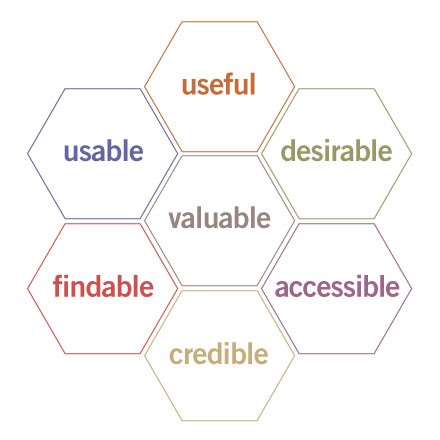
<p><img src="/assets/honeycomb.jpg" alt="The User Experience Honeycomb, by Peter Morville" />
<a href="http://semanticstudios.com/publications/semantics/000029.php">The User Experience Honeycomb</a>, by Peter Morville</p>

<p>To see the limits of this view, we need to turn to <a href="http://semanticstudios.com/publications/semantics/000029.php">Peter Morville’s work</a> on user experience.</p>

<p>His definition of the qualities of a good UX comes down to seven attributes:</p>

<ul>
  <li>Useful</li>
  <li>Usable</li>
  <li>Accessible</li>
  <li>Desirable</li>
  <li>Findable</li>
  <li>Credible</li>
  <li>Valuable</li>
</ul>

<p>Ergonomics focuses mostly on the Useful, Usable and Accessible attributes. Good UX designers cover all the attributes Peter Morville describes, especially desirability, credibility and value.</p>

<p>To make a (caricatural) culinary analogy: the ergonomist would make pills containing everything needed for a balanced diet, while the UX designer would encourage cooking delicious meals.</p>

<h2 id="scientific-method-or-abductive-reasoning">Scientific method, or abductive reasoning</h2>

<p>Another difference between ergonomics and UX Design is the weight each gives to scientific proof.</p>

<p>As the SELF definition shows, ergonomics makes a point of stating that its methods are scientific. The scientific element has many advantages:</p>

<ul>
  <li>An ergonomist delivers scientific proof of every ergonomic flaw.</li>
  <li>Clients cannot dispute that the solution an ergonomist proposes is better than the original one.</li>
  <li>The scientific cover gives a certain legitimacy.</li>
</ul>

<p>But for some clients, a scientific approach is often misunderstood, and it scares them. The best way to convince them is simply to show users using their app, website or service.</p>

<p>For these battles, the UX designer is better equipped (defining <a href="http://uxmag.com/articles/creating-a-shared-vision-that-works">a shared vision</a>, <a href="http://uxmag.com/articles/introduction-to-design-studio-methodology">co-creation workshops</a>) to create a solution that all stakeholders will buy into.</p>

<h2 id="from-the-humanmachine-interface-to-the-whole-experience">From the human–machine interface to the whole experience</h2>

<p>Ergonomics has its roots in the design of the human–machine interface: the interface created between a machine and the user.</p>

<p>As for user experience, Marc Hassenzahl writes in his <a href="http://interaction-design.org/encyclopedia/user_experience_and_experience_design.html">article on UX Design</a>:</p>

<blockquote>
  <p>“Experience or User Experience is not about technology, industrial design, or interfaces. It is about creating a meaningful experience through a device.”</p>
</blockquote>

<p>Some companies are very good at creating a rich experience:</p>

<ul>
  <li><a href="http://www.apple.com">Apple</a> is the unavoidable example, where every minute counts: <a href="http://www.apple.com/fr/retail/opera/">buying</a>, <a href="http://www.youtube.com/results?search_query=unboxing+apple">unboxing a product</a>, and <a href="http://www.youtube.com/watch?v=pT4EbM7dCMs">using</a> it.</li>
  <li><a href="http://www.moo.com">Moo</a>, a business card printer, has built a particularly well-integrated concept, where the customer is held by the hand from start to <a href="http://www.flickr.com/photos/cullinanecj/8220916264/in/pool-moo/">delivery</a> of the cards.</li>
  <li>The In-n-Out fast-food chain in California shows another kind of user experience. Their menu is <a href="http://www.flickr.com/photos/35975251@N08/5336341609/in/photostream/">as simple as it gets</a>. Yet the restaurant is famous for how fresh its food is (everything is made to order, down to cutting the potatoes). And for the “experts” who want something more, there’s a “<a href="http://aht.seriouseats.com/archives/2011/03/the-in-n-out-survival-guide-we-ate-every-single-item-on-the-secret-menu.html">secret menu</a>” with more than 40 combinations.</li>
</ul>

<p><img src="/assets/in-n-out-menu.jpg" alt="The In-n-Out menu: 3 burgers, 1 portion of fries, 1 milkshake. Image from Flickr" />
The In-n-Out menu: 3 burgers, 1 portion of fries, 1 milkshake. Image from <a href="http://www.flickr.com/photos/35975251@N08/5336341609/in/photostream/">Flickr</a></p>

<p>What these examples share is that they go beyond the product (the iPad, the business card, the burger) to cover the whole experience a future user has with it.</p>

<p>Is it the UX designer’s job to design this kind of experience? Not necessarily. But they should be the ones spotting these opportunities and opening up what’s possible.</p>

<h3 id="objective-design-or-emotional-impact">Objective design, or emotional impact</h3>

<p>UX Design seeks emotional impact, while ergonomics focuses on the objectivity of the service offered.</p>

<p>To illustrate this, let’s quote David Malouf (former professor of Interaction Design, one of the disciplines of UX Design, at the Savannah College of Art and Design), quoted by Whitney Hess in <a href="http://www.slideshare.net/whitneyhess/10-most-common-misconceptions-about-user-experience-design">10 most common misconceptions about UX Design</a>:</p>

<blockquote>
  <p>“While usability is important, its focus on efficiency and effectiveness seems to blur the other important factors in UX, which include learnability and <strong>visceral</strong>, and <strong>behavioral emotional responses</strong> to the products and the services we use.”</p>
</blockquote>

<p>In other words, user experience design seeks to create an emotional response in the user.
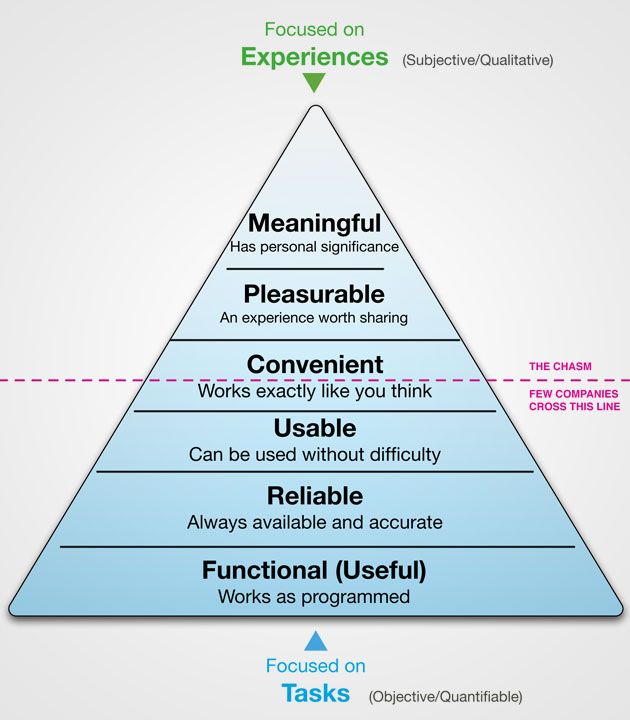
If we take Peter Morville’s honeycomb and lean on <a href="https://en.wikipedia.org/wiki/Maslow%27s_hierarchy_of_needs">Maslow’s pyramid</a>, we get this: ergonomics focuses on the useful and the usable, while UX Design brings a pleasurable, personal experience.</p>

<p><img src="/assets/pyramid-of-needs.jpg" alt="The pyramid of user experience needs (origin unknown)" />
The pyramid of user experience needs (origin unknown)</p>

<p>Useful and usable are clearly basic needs. Without them, the application, website or service can’t even be approached by the user.
But what sets any company apart is going further and creating a strong relationship between the software and its user. UX Design is then the cornerstone of a setup that generates ideas <strong>beyond</strong> the usable and gets closer to that personal relationship between the service and the user.</p>

<h3 id="the-myth-that-ux-is-only-for-consumer-products">The myth that UX is only for consumer products</h3>

<p>It’s true that this effort matters most for software aimed at the general public, where competition is often fierce and the experience sets products apart.</p>

<p>But today, this richness of experience is also sought in services and applications for businesses and employees: an employee will feel attached to a company that gives them powerful tools designed for them. And no amount of money will make up for bad tools.</p>

<h2 id="creating-emotional-impact-doesnt-mean-making-a-pretty-interface">Creating emotional impact doesn’t mean making a pretty interface</h2>

<p>Some people equate UX Design (often even ergonomics) with the look of the application or website. Yet while aesthetics adds to an application’s credibility and steers the user towards its message, it’s not the only lever: the tone of voice (see <a href="http://voiceandtone.com">Mailchimp’s work</a> on the tone of their communication), the overall layout, or the interactions on offer (<a href="http://vimeo.com/35693267">the gesture language</a> of <a href="http://www.realmacsoftware.com/clear/">Clear</a>) are all ways to give an application character, entirely apart from traditional visual aesthetics.</p>

<p>Yes, an application’s aesthetics matter for emotional impact. But they are not the whole of the UX Design approach.</p>

<h3 id="common-ground-differences-and-the-future-of-ergonomics">Common ground, differences, and the future of ergonomics</h3>

<p><img src="/assets/dan-saffer-s-disciplines-of-ux.jpg" alt="The disciplines of user experience by Dan Saffer" />
<a href="http://www.kickerstudio.com/2008/12/the-disciplines-of-user-experience/">The disciplines of user experience</a> by Dan Saffer</p>

<p>When you look at how some ergonomists work, you notice that their field isn’t limited to the activities in the SELF definition, and that they go beyond evaluating problems to propose solutions. Ergonomists often have to take on the role of user experience designer to do their job well; likewise, UX designers must always apply ergonomic practices and methods. Without them, the solution delivered wouldn’t even be usable.
On some projects, an ergonomist and a UX designer even work side by side.</p>

<p>In short, this article focuses mostly on the differences between ergonomists and UX designers, but the two professions are very close. For many UX designers, including Dan Saffer in his article <a href="http://www.kickerstudio.com/2008/12/the-disciplines-of-user-experience/">The Disciplines of User Experience</a>, ergonomics is entirely part of the UX designer’s job.</p>

<p>We’ll come back to this in a future article. If I insist on the differences today, it’s to show clearly that UX designer and ergonomist are not interchangeable professions.</p>

<p>If there were only one proof that the ergonomist’s profession is inevitably evolving towards UX design: the UPA (Usability Professionals’ Association, whose French chapter is called FLUPA), an international community of usability professionals, renamed itself UXPA (User Experience Professionals Association) last year…</p>]]></content><author><name>Gilles Demarty</name></author><category term="definitions" /><category term="ergonomist" /><category term="ux design" /><category term="differences" /><category term="ergonomics" /><category term="usable" /><category term="scientific method" /><category term="experience" /><summary type="html"><![CDATA[When I started at SQLi, I signed an employment contract as an Expert Ergonomics Consultant.]]></summary><media:thumbnail xmlns:media="http://search.yahoo.com/mrss/" url="https://demarty.ch/assets/portrait.jpg" /><media:content medium="image" url="https://demarty.ch/assets/portrait.jpg" xmlns:media="http://search.yahoo.com/mrss/" /></entry><entry xml:lang="en"><title type="html">Welcome to my workshop</title><link href="https://demarty.ch/blog/bienvenue-dans-mon-atelier-dux/" rel="alternate" type="text/html" title="Welcome to my workshop" /><published>2013-04-01T10:16:01+02:00</published><updated>2013-04-01T10:16:01+02:00</updated><id>https://demarty.ch/blog/welcome-to-my-workshop</id><content type="html" xml:base="https://demarty.ch/blog/bienvenue-dans-mon-atelier-dux/"><![CDATA[<p>Dear reader,
Welcome to my blog.</p>

<p>Today I’m starting this series of articles to talk about something close to my heart: my craft, user experience design.</p>

<p>Through these articles, I hope to show you what my days look like, where I’m heading, why what I do matters, and to answer any questions you may have.</p>

<p>And please, don’t hesitate to react!</p>

<p>See you very soon, and I look forward to reading your thoughts.
Gilles.</p>]]></content><author><name>Gilles Demarty</name></author><category term="introduction" /><category term="blog" /><category term="ux design" /><category term="welcome" /><category term="false" /><summary type="html"><![CDATA[Dear reader, Welcome to my blog.]]></summary><media:thumbnail xmlns:media="http://search.yahoo.com/mrss/" url="https://demarty.ch/assets/portrait.jpg" /><media:content medium="image" url="https://demarty.ch/assets/portrait.jpg" xmlns:media="http://search.yahoo.com/mrss/" /></entry></feed>