When I started at SQLi, I signed an employment contract as an Expert Ergonomics Consultant.
In the same way, when I talk with clients, they often call me an ergonomist and talk about “the ergonomics I did”.
And yet I have a confession to make: I am not an ergonomist.
Not that I don’t apply ergonomic principles in my daily work: I know how to use them, and I know the limits of Miller’s number, of Hick’s and Fitts’s laws, and of the Gestalt principles. I know how to use Scapin and Bastien’s heuristic criteria, and I know the main biases to watch for when I organise and facilitate user tests.
I am not an ergonomist; I am a User eXperience Designer… and a User eXperience Designer is NOT an ergonomist.
It’s a fact: ergonomists and designers are often lumped together in the web world, but they are quite different.
Let’s walk together through what sets Ergonomics apart from User eXperience Design (which I’ll call UX Design). Along the way, we’ll show that UX Design, when it’s done well, is better placed to meet the needs of users AND of the client who hires me.
Defining ergonomics
One of the reasons (too often pointed out by my ergonomist colleagues) that makes me say I’m not an ergonomist is that I didn’t follow the five-year university track that leads to an ergonomics degree, the sine qua non condition for calling yourself an ergonomist professionally. So I fall into the category of troubadours, as Raphaël puts it. According to the definition of SELF (the French-speaking ergonomics society):
Ergonomists contribute to the design and evaluation of tasks, products, working conditions and systems to make them compatible with the needs, abilities, possibilities and limits of human beings.
The goal of ergonomics is therefore to make a tool usable.
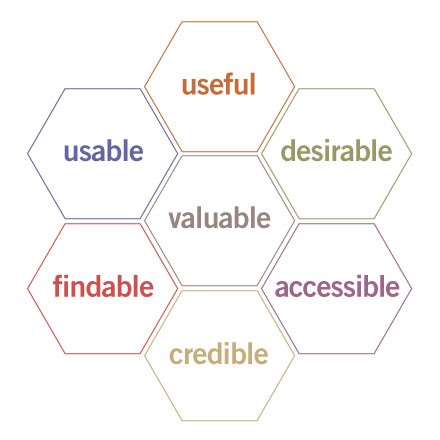 The User Experience Honeycomb, by Peter Morville
To see the limits of this view, we need to turn to Peter Morville’s work on user experience.
His definition of the qualities of a good UX comes down to seven attributes:
- Useful
- Usable
- Accessible
- Desirable
- Findable
- Credible
- Valuable
Ergonomics focuses mostly on the Useful, Usable and Accessible attributes. Good UX designers cover all the attributes Peter Morville describes, especially desirability, credibility and value.
To make a (caricatural) culinary analogy: the ergonomist would make pills containing everything needed for a balanced diet, while the UX designer would encourage cooking delicious meals.
Scientific method, or abductive reasoning
Another difference between ergonomics and UX Design is the weight each gives to scientific proof.
As the SELF definition shows, ergonomics makes a point of stating that its methods are scientific. The scientific element has many advantages:
- An ergonomist delivers scientific proof of every ergonomic flaw.
- Clients cannot dispute that the solution an ergonomist proposes is better than the original one.
- The scientific cover gives a certain legitimacy.
But for some clients, a scientific approach is often misunderstood, and it scares them. The best way to convince them is simply to show users using their app, website or service.
For these battles, the UX designer is better equipped (defining a shared vision, co-creation workshops) to create a solution that all stakeholders will buy into.
From the human–machine interface to the whole experience
Ergonomics has its roots in the design of the human–machine interface: the interface created between a machine and the user.
As for user experience, Marc Hassenzahl writes in his article on UX Design:
“Experience or User Experience is not about technology, industrial design, or interfaces. It is about creating a meaningful experience through a device.”
Some companies are very good at creating a rich experience:
- Apple is the unavoidable example, where every minute counts: buying, unboxing a product, and using it.
- Moo, a business card printer, has built a particularly well-integrated concept, where the customer is held by the hand from start to delivery of the cards.
- The In-n-Out fast-food chain in California shows another kind of user experience. Their menu is as simple as it gets. Yet the restaurant is famous for how fresh its food is (everything is made to order, down to cutting the potatoes). And for the “experts” who want something more, there’s a “secret menu” with more than 40 combinations.
 The In-n-Out menu: 3 burgers, 1 portion of fries, 1 milkshake. Image from Flickr
What these examples share is that they go beyond the product (the iPad, the business card, the burger) to cover the whole experience a future user has with it.
Is it the UX designer’s job to design this kind of experience? Not necessarily. But they should be the ones spotting these opportunities and opening up what’s possible.
Objective design, or emotional impact
UX Design seeks emotional impact, while ergonomics focuses on the objectivity of the service offered.
To illustrate this, let’s quote David Malouf (former professor of Interaction Design, one of the disciplines of UX Design, at the Savannah College of Art and Design), quoted by Whitney Hess in 10 most common misconceptions about UX Design:
“While usability is important, its focus on efficiency and effectiveness seems to blur the other important factors in UX, which include learnability and visceral, and behavioral emotional responses to the products and the services we use.”
In other words, user experience design seeks to create an emotional response in the user. If we take Peter Morville’s honeycomb and lean on Maslow’s pyramid, we get this: ergonomics focuses on the useful and the usable, while UX Design brings a pleasurable, personal experience.
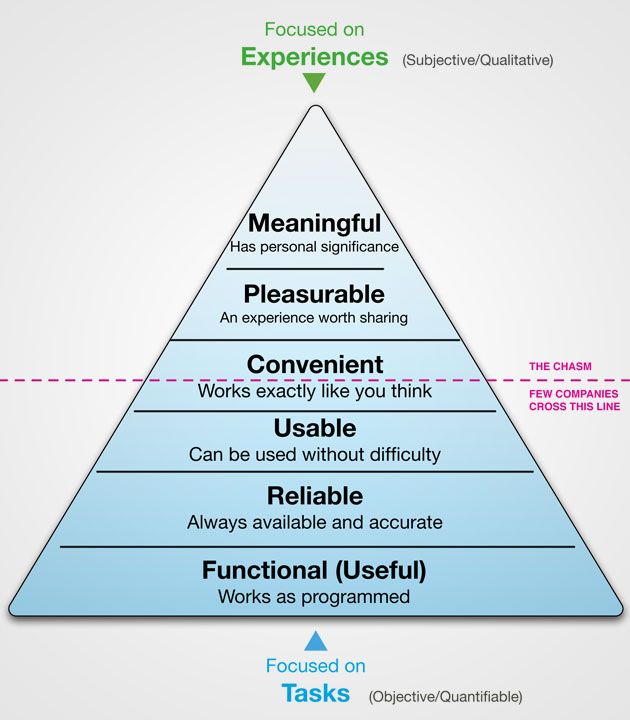 The pyramid of user experience needs (origin unknown)
Useful and usable are clearly basic needs. Without them, the application, website or service can’t even be approached by the user. But what sets any company apart is going further and creating a strong relationship between the software and its user. UX Design is then the cornerstone of a setup that generates ideas beyond the usable and gets closer to that personal relationship between the service and the user.
The myth that UX is only for consumer products
It’s true that this effort matters most for software aimed at the general public, where competition is often fierce and the experience sets products apart.
But today, this richness of experience is also sought in services and applications for businesses and employees: an employee will feel attached to a company that gives them powerful tools designed for them. And no amount of money will make up for bad tools.
Creating emotional impact doesn’t mean making a pretty interface
Some people equate UX Design (often even ergonomics) with the look of the application or website. Yet while aesthetics adds to an application’s credibility and steers the user towards its message, it’s not the only lever: the tone of voice (see Mailchimp’s work on the tone of their communication), the overall layout, or the interactions on offer (the gesture language of Clear) are all ways to give an application character, entirely apart from traditional visual aesthetics.
Yes, an application’s aesthetics matter for emotional impact. But they are not the whole of the UX Design approach.
Common ground, differences, and the future of ergonomics
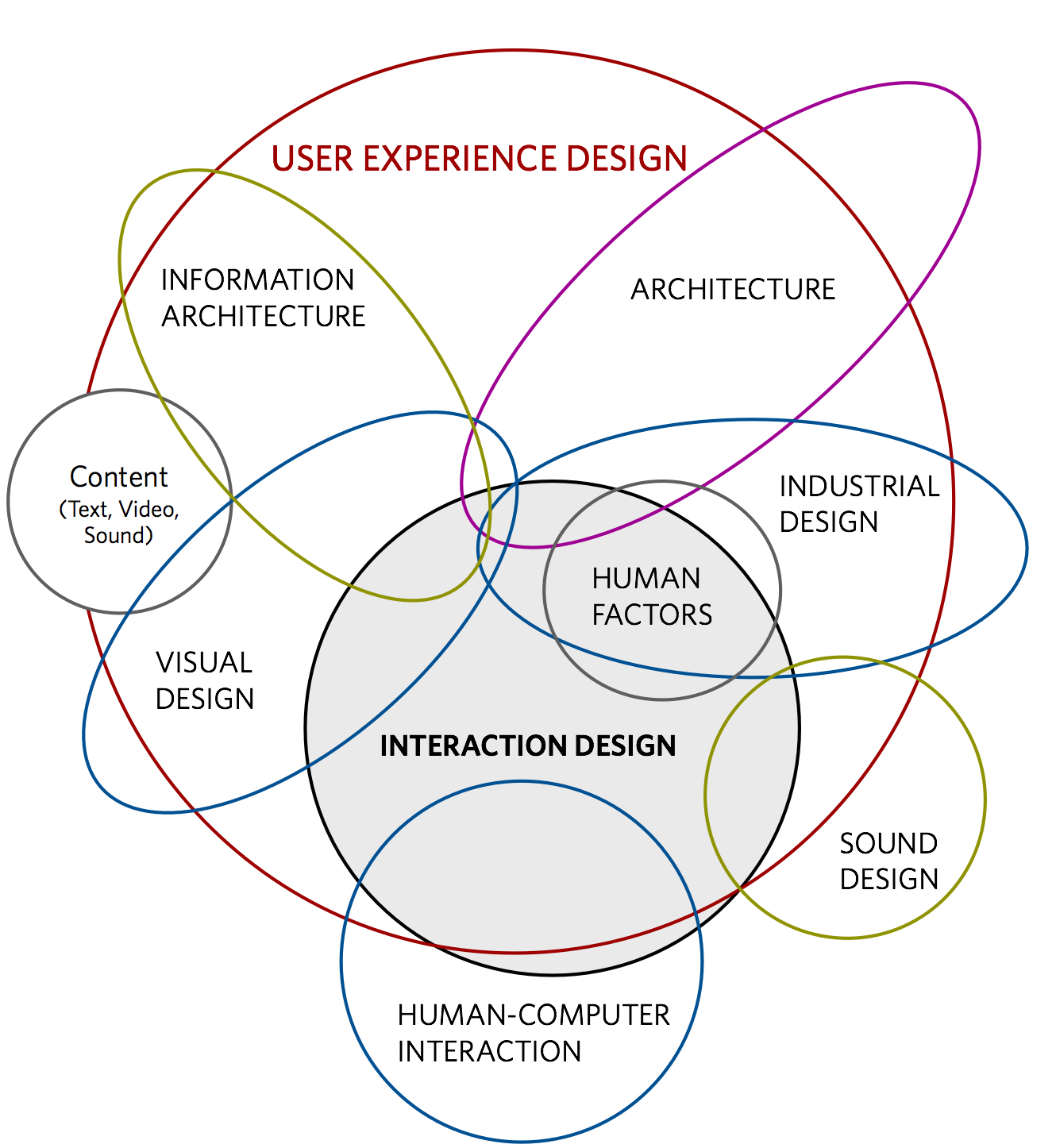 The disciplines of user experience by Dan Saffer
When you look at how some ergonomists work, you notice that their field isn’t limited to the activities in the SELF definition, and that they go beyond evaluating problems to propose solutions. Ergonomists often have to take on the role of user experience designer to do their job well; likewise, UX designers must always apply ergonomic practices and methods. Without them, the solution delivered wouldn’t even be usable. On some projects, an ergonomist and a UX designer even work side by side.
In short, this article focuses mostly on the differences between ergonomists and UX designers, but the two professions are very close. For many UX designers, including Dan Saffer in his article The Disciplines of User Experience, ergonomics is entirely part of the UX designer’s job.
We’ll come back to this in a future article. If I insist on the differences today, it’s to show clearly that UX designer and ergonomist are not interchangeable professions.
If there were only one proof that the ergonomist’s profession is inevitably evolving towards UX design: the UPA (Usability Professionals’ Association, whose French chapter is called FLUPA), an international community of usability professionals, renamed itself UXPA (User Experience Professionals Association) last year…