Following my previous article, it now seems important to define what UX Design (User eXperience Design) is and, by extension, what a UX designer is.
In his article on design education (Moholy-Nagy’s Design Pedagogy in Chicago (1937-46)), Alain Findeli sets the tone:
“Anybody who has been confronted with design education would readily admit that proposing a satisfactory definition of Design is a rather risky, if not impossible, enterprise. Its definition indeed depends on whether design is considered to be an idea, a knowledge, a project, a process, a product or even a Way-of-being.”
So I’m clearly setting out on a risky journey into defining user experience design. Still, I think it’s a necessary step to define my own practice and explain it to people outside the industry.
It’s reductive to describe UX Design as “ergonomics” or “graphic design”, just as it’s reductive to describe it as web design or app design.
Given the size of the task, rather than offering one unifying definition, I’ll describe UX design from five different angles.
Here is where my thinking stands.
Definition 1: UX Design as the design of the user experience
The most immediate definition, the closest to the very essence of UX Design, is that UX Design is the design of the user experience, just as product design is the design of a “product”. UX Design is then a design discipline, and the user experience is the material the designer works with.
So let’s define the user experience: as Marc Hassenzahl explains, it comes from a recent shift in society: from consuming products to consuming experiences.
This shift towards an experience society has also been anticipated and recognised by fields other than design, such as business and marketing.
Jared Spool, for his part, described it as the gap between several activities (or tasks) lived between a customer and a service. He takes the example of the “experience” at Disneyland Paris, where the different rides dissolve into the overall “Disney” experience.
Definition 2: UX Design as a problem-solving tool (mostly digital)
By definition, design is a creative method for solving problems in two key moments: reframing and repositioning the problem, and exploring the solution space to bring out a “good” solution.
Of course, designers aren’t the only ones whose job is solving problems. To be honest, every service and scientific profession solves problems. What makes designers unique is the nature of the problems they solve: problems solved by design are, in essence, non-deterministic (see the definition of wicked problems).
Wicked problems are a class of social system problems which are ill-formulated, where the information is confusing, where there are many clients and decision makers with conflicting values, and where the ramifications in the whole system are thoroughly confusing.
The design process guarantees a better result than having no design process (but not the best possible result). That said, the designer’s solution won’t meet every stated constraint, but it will define the essence of what gets made. The designer works towards that by exploring the problem space and then the solution space, iteratively and (often) visually: building sketches and prototypes as concrete outputs, and knowing the limits and possibilities of the material used (in our case, the experience).
It’s the non-determinism of the process that worries clients
A short aside here. In my previous assignment, I worked in an environment where design was fundamentally misunderstood (see the previous article). When I introduced myself as a UX designer, I was confused with ergonomists or graphic designers, whose goals were just as unknown but whose results were more visible. Either way, the value I added wasn’t really seen, because people assumed that:
- I would propose a solution that couldn’t be built,
- I would spend more time finding a solution they’d have had anyway without me.
At the heart of these concerns is a fear of the unknown, a place where we designers are naturally at home, and which is our strength.
Definition 3: UX Design as a multidisciplinary profession
Surprisingly, an activity as fuzzy as UX Design breaks down into many skills or disciplines, all more or less well defined:
- Interaction design,
- Information architecture,
- Visual design or graphic design.
Many other fields are also present, either at the core of the UX designer’s practice or as inspiration:
- Cognitive ergonomics
- Human sciences
- Project management
- Front-end development
- Architecture
- Product design
- Service design
- And many more!
These professions, without being an integral part of the design process, are all disciplines the UX designer must know, if not master.
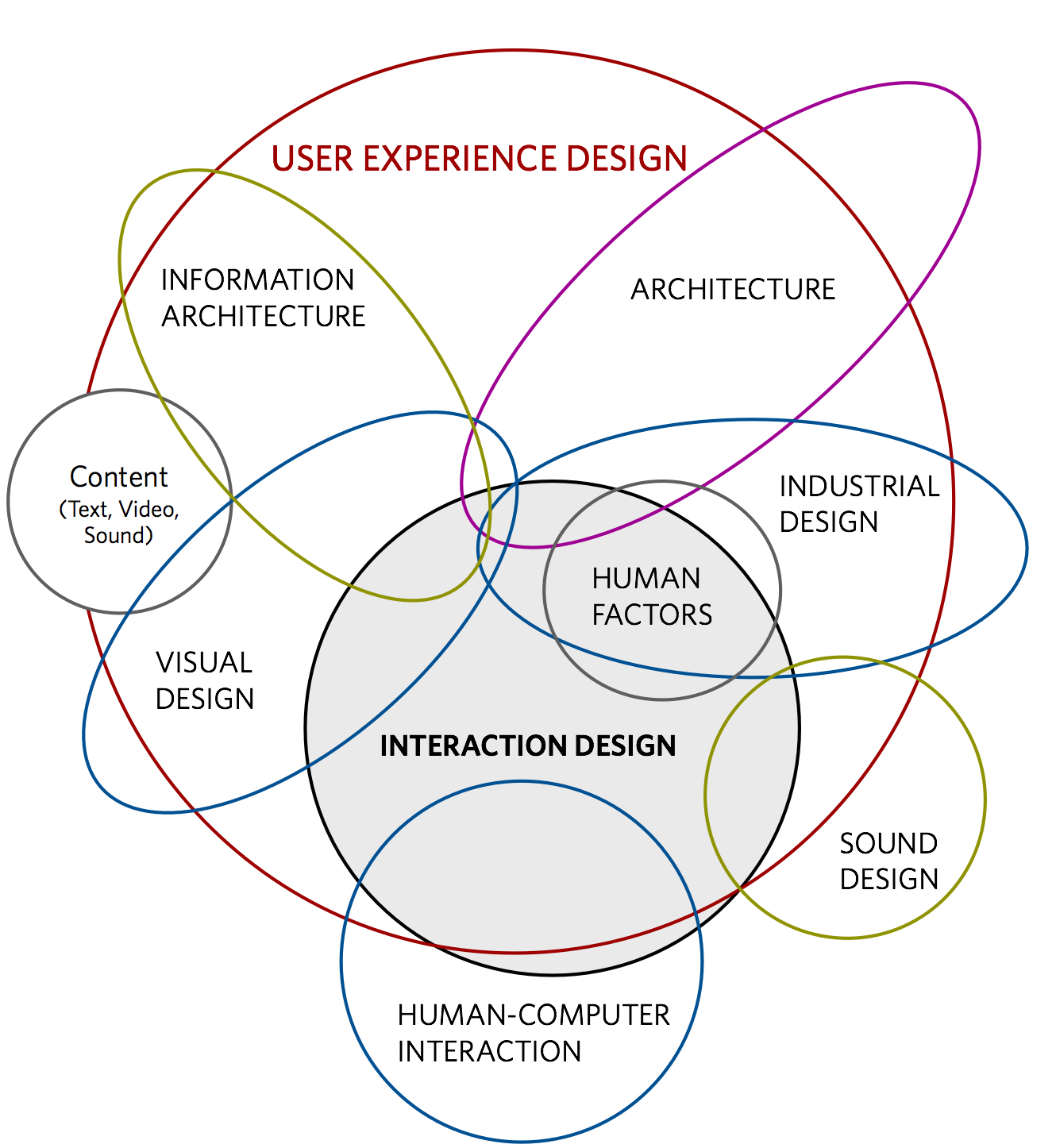 The disciplines of user experience by Dan Saffer
The UX designer has a T-shaped profile
A UX designer is expected to have a T-shaped practice:
- Broad, more or less applied knowledge across many fields, from ergonomics to front-end development, including psychology, typography, print design, interface design, and so on.
- But above all, one key skill in their practice that makes them unique.
Facilitator and conversation starter
One strength of a UX designer is the ability to talk with everyone in the room, to translate and facilitate between trades. That’s also why they need to understand all these disciplines.
Definition 4: UX Design as a company philosophy and culture
Once design is established in a company, the company is radically transformed at its foundations. Signs that a company has made its “experience” shift:
- The walls between departments come down,
- All departments are involved in designing the overall customer experience (CX),
- A real company-wide culture, disruptive and creative, that accepts failure, is present.
Once the benefits of UX Design are understood, adoption can be quick.
Definition 5: UX Design as an agent of change
Of course, not every company or organisation has reached full UX Design maturity. For companies drawn to the design approach, the UX designer then acts as a catalyst, setting off a chain reaction wherever they go and raising the company’s overall maturity.
That’s what I consider user experience design to be, and what I believe I do day to day in my UX design practice.